This example shows findings from assessments of heart rate and heart rate variability from an industry study. It is not based on a DiMe Digital Endpoint, although there are Dime Digital Endpoints which involve heart rate and heart rate variability.
An Apple Watch was used in this study.
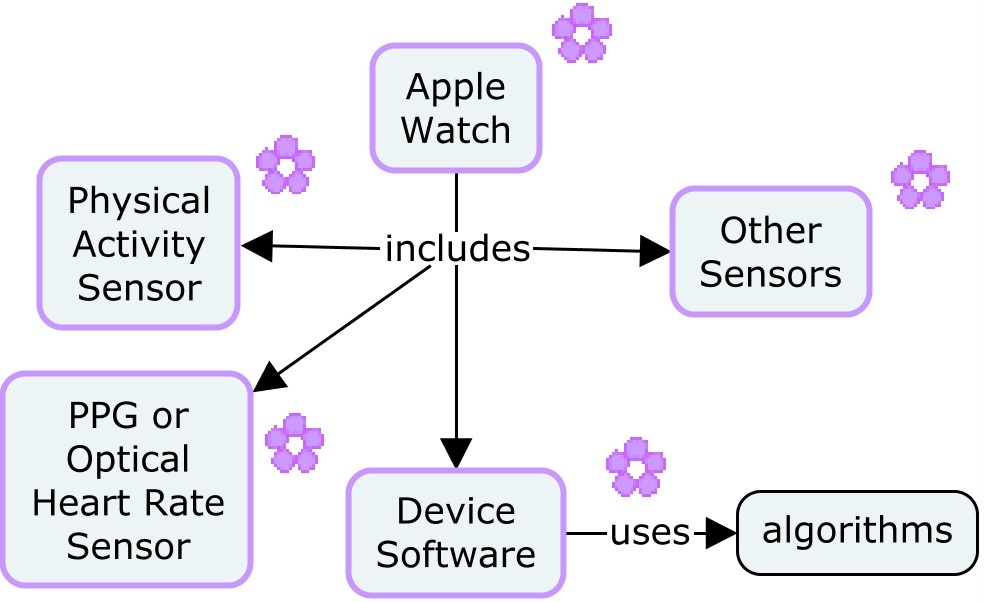
The sensors in an Apple Watch are described here Here are all the sensors on your Apple Watch — and what they do - MyHealthyApple. The sensors used for the heart rate data in this example are the photoplethysmography (PPG) sensor, also known as an optical heart rate sensor, and an accelerometer, which measures movement. Most of the measurements used in this example are from the optical heart rate sensor, but Average Resting Heart Rate requires data from the physical activity sensor.
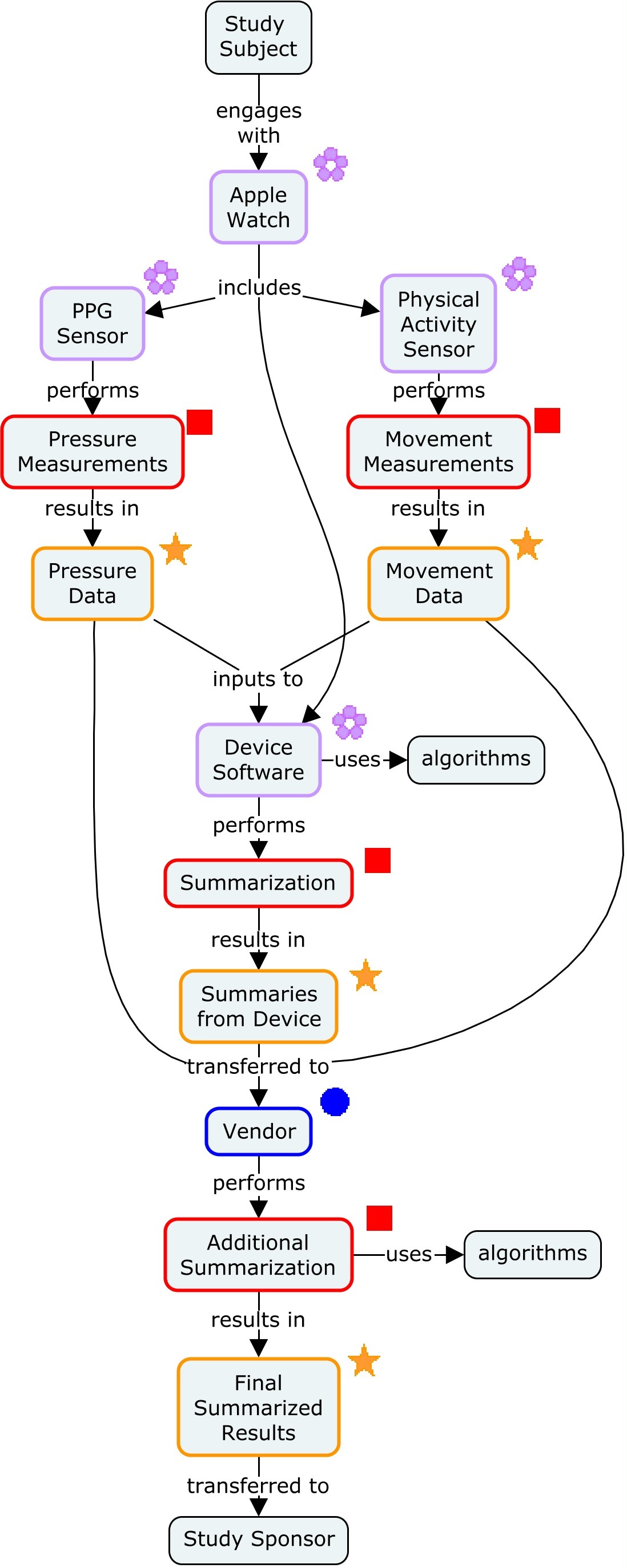
Raw data from the sensors in an Apple Watch is summarized by software within the Apple Watch and displayed to the subject wearing it.
For this study, the data from the Apple Watch is collected by a vendor, who uses the data from the device to perform further summarization and transfers data, in an agreed format, to the sponsor.
The algorithms within the Apple Watch and those used by the vendor are not provided to the sponsor.
The devices are modeled as biomedical concepts separate from the findings. They are represented in the SDTM datasets Device Identifiers (DI) and the Related Devices (RELDEV). The relevant devices in this example are
- The Apple Watch, a Monitoring Device, C41278, defined as "A recording device or display that continuously keeps track of the function, condition, or operation of the system or organism and warns of an abnormal or potentially dangerous situation."
- The software within the Apple Watch, a Sensor Signal Device, C218444, defined as, "A device designed to analyze, enhance, interpret, or display signals from one or more sensor devices."
- The PPG sensor, C224112, defined as, "A non-invasive optical sensor that measures changes in blood volume beneath the skin using light. It is widely used in wearables to track heart rate, oxygen saturation, and other cardiovascular signals. defined as, "A non-invasive optical sensor that measures changes in blood volume beneath the skin using light. It is widely used in wearables to track heart rate, oxygen saturation, and other cardiovascular signals."
- The movement sensor, an Actigraphy Sensor, C218443, defined as, "A sensor designed for continuous, or near-continuous, monitoring of body movement."
The heart rate data produced by the device are biomedical concepts which are represented in an SDTM Findings domain.
The name of the findings biomedical concept maps to the SDTM variables --TESTCD and --TEST. The concept map above is for Average Heart Rate captured over a 24-hour period.
This table shows the mapping of the data element concepts (DECs) to the variables in the SDTM Cardiovascular System Findings (CV) domain.
| Device | SPDEVID |
| Method | CVMETHOD |
| Analytical Method | CVANMETH |
| Result | CVORRES, CVSTRESC, CVSTRESN |
| Unit | CVORRESU, CVSTRESU |
| Start Datetime | CVDTC |
| End Datetime | CVENDTC |
Other findings in the data delivered to the sponsor are:
- Heart Rate – This is a point-in-time measurement which uses only CVDTC
- Average Resting Heart Rate – This summary includes only time periods during which the subject was determined, through movement data, to be at rest. This filtering was represented by a non-standard variable.
- Heart Rate Variability – Although there are several measures of heart rate variability, we believe that this is the Biomedical Concept C199682, HRVSDNN, "Heart Rate Variability, SDNN," defined as "A measurement of the fluctuation in the time intervals between adjacent heartbeats, based on the standard deviation of the NN interval." The NN interval is the inter-beat interval.
The following should be considered when viewing this resource:
- Although it is likely that the sponsor would need an identifier (SPDEVID) for only the Apple Watch as a whole, each component is included in the DI dataset example and a RELDEV example is included to illustrate how components could be represented, if needed. Similarly, Biomedical Concepts and SDTM Specializations for the component devices are included.
- This example represents heart rate in the Cardiovascular System Findings (CV) domain. Heart rate is a clearly a cardiovascular system finding; its inclusion in the SDTM ECG Test Results (EG) and Vital Signs (VS) domains is due to historical decisions about SDTM domain formation. Since the method used for these findings is not an ECG machine and this is not a measurement taken with a group of vital signs, the results in this example are represented in the CV domain.
- The test "ECG Mean Heart Rate" EGHRMN, C119259, is in CDISC CT, but the definition starts, "An electrocardiographic measurement ...", so presumably this test can be used only for data collected by ECG. The high level biomedical concept "Mean Heart Rate" would not specify method, but there could be SDTM specializations with different methods.
- Heart rate is measured by the PPG sensor, and the CVMETHOD value has been given the value "PHOTOPLETHYSMOGRAPHY" for heart rate, average heart rate, and heart rate variability. Whether the subject is resting is derived from accelerometer data, so "ACTIGRAPHY" also contributes to the measure of resting heart rate. For the measure of resting heart rate, the MULTIPLE convention was used to represent the two methods for resting heart rate with two non-standard method variables.
- The example SDTM dataset represents the "Average" part of "Average Heart Rate" and "Average Resting Heart Rate" with CVCOLSRT = "MEAN". The variable--COLSRT was originally created to handle situations where source records included, during a period of time, multiple values for a measurement, but only a summary of those measurements was collected on a CRF. Whether --COLSRT should be used in situations where source data are summarized by a device is an open question. An argument for using --COLSRT would be that the source data from the device is not represented in SDTM. In the CRF case, the source data is not transcribed to the CRF. In the device case, the raw data from the device may be too voluminous to be usefully represented in SDTM. It may or may not have been transferred from the vendor to the study sponsor.
- Heart rate variability can be measured in several ways. The measure used in this example, SDNN, is generally measured over a 24-hour period and is considered the gold standard for clinical assessment.
Known Issue
"Resting heart rate" is commonly used to refer to a point-in-time measurement taken when the subject is known to have been relatively inactive for a period of time. The measurement of "mean resting heart rate" in this example relies on two kinds of data from the device, a heart rate measurement, and a determination by the device that the subject is in a resting state. The mean resting heart rate is a summary over a 24-hour period of heart rate that includes only measurements at times when the device determines the subject to be "resting." One can conceive of similar summaries, such as the mean heart rate during time the subject is asleep or during time the subject is engaging in moderate exercise.
In this example, the "filtering" of the mean heart rate summary to "resting' periods contrasts with the unfiltered mean summary. The two were represented using a non-standard variable, "Include non-resting times" with the value of "N" for mean resting heart rate and "Y" for mean heart rate. This is not a very satisfactory approach for the more general approach of filtering the measurements included in a summary measure, and it is hoped that a more elegant approach can be found. The non-standard variable used in this example was not included in the SDTM Specialization of the Biomedical Concept Summary (Mean) Heart Rate.
References
- Shaffer F, Ginsberg JP. An Overview of Heart Rate Variability Metrics and Norms. Front Public Health. 2017 Sep 28;5:258. doi: 10.3389/fpubh.2017.00258. PMID: 29034226; PMCID: PMC5624990 An Overview of Heart Rate Variability Metrics and Norms - PMC
- Task Force Report. Heart rate variability: standards of measurement, physiological interpretation, and clinical use. Circulation (1996) 93:1043–65. 10.1161/01.CIR.93.5.1043 Heart Rate Variability | Circulation
- Shaffer F, McCraty R, Zerr CL. A healthy heart is not a metronome: an integrative review of the heart’s anatomy and heart rate variability. Front Psychol (2014) 5:1040. 10.3389/fpsyg.2014.01040 Frontiers | A healthy heart is not a metronome: an integrative review of the heart's anatomy and heart rate variability
- Heart rate variability - Wikipedia
- Charlton PH, Kyriaco PA, Mant J, Marozas V, Chowienczyk P, Alastruey J. Wearable Photoplethysmography for Cardiovascular Monitoring. Proc IEEE Inst Electr Electron Eng. 2022 Mar 11;110(3):355-381. doi: 10.1109/JPROC.2022.3149785. PMID: 35356509; PMCID: PMC7612541.
The example DI dataset shows how the devices modelled are described (parameters used) and the device identifiers (SPDEVID values) given to the devices. If the stud does not need to assign identifiers to components of the Apple Watch, the DI dataset may include only parameters for the Apple Watch as a whole.
di.xpt
Rows 1-3: Show the device type, manufacturer, and model number for the Apple Watch, given the SPDEVID = "Apple Watch".
Rows 4-5: Show the device types for the two sensors given the SPDEVID values "PPG Sensor" and "Accelerometer".
Rows 6-7: Show the device type sensor signalling software, identified with SPDEVID = "Apple Watch Software".
di.xpt
| Row | STUDYID | DOMAIN | SPDEVID | DISEQ | DIPARMCD | DIPARM | DIVAL |
|---|---|---|---|---|---|---|---|
| 1 | ABC-123 | DI | Apple Watch | 1 | DEVTYPE | Device Type | Monitoring device |
| 2 | ABC-123 | DI | Apple Watch | 2 | MANUF | Manufacturer | Apple |
| 3 | ABC-123 | DI | Apple Watch | 3 | MODEL | Model Number | Apple Watch SE 3 |
| 4 | ABC-123 | DI | PPG Sensor | 4 | DEVTYPE | Device Type | Photoplethymography sensor |
| 5 | ABC-123 | DI | Accelerometer | 5 | DEVTYPE | Device Type | Actigraphy sensor |
| 6 | ABC-123 | DI | Apple Watch Software | 6 | DEVTYPE | Device Type | Sensor signal processor |
Relevant heart rate data from the device output file have been mapped to the following Cardiovascular System Findings (CV) domain dataset.
- SPDEVID (Device Identifier) is defined in the Device Identifier (DI). In this study, the implementer chose to use an identifier that identified the Apple Watch as a whole.
Although currently heart rate data is represented in the VS or EG domain, in this example, it is represented in the Cardiovascular System Findings (CV) domain. This is to avoid the awkward choice presented by the presence of Heart Rate tests in both the EG and VS domains.
This example dataset includes one record for each of the tests of interest.
cv.xpt
Row 1: Shows an assessment of heart rate at the time represented in CVDTC.
Row 2: Shows the average (CVCOLSRT = "MEAN") heart rate over the time period represented by CVDTC and CVENDTC. In this example, the time period is assumed to be a calendar day. The starts and ends of the time period are assumed to be known down to the minute. The non-standard variable (supplemental qualifier) CVNREST (Includes Non-Resting Times) value "Y" indicates that this summary includes both periods when the subject is resting and not resting.
Row 3: Shows another average of heart rate over the same day, but one that includes only observations for which a filtering variable indicated that the subject was resting. In this example, a nonstandard variable is used to represent the filtering. The value of CVMETHOD is "MULTIPLE" since the PPG sensor provides heart rate and the actigraphy determines resting periods. The non-standard variable (supplemental qualifier) CVNREST (Includes Non-resting Times) value "N" indicates that this summary includes only periods when the subject is resting.
Row 4: Shows a daily summary of heart rate variability. This measure of heart rate is based on the SDNN, Standard Deviation of NN intervals. The planned time period for measurement is 24 hours, as indicated by CVPDUR = "P24H".
cv.xpt
| Row | STUDYID | DOMAIN | USUBJID | SPDEVID | CVSEQ | CVTESTCD | CVTEST | CVORRES | CVORRESU | CVCOLSRT | CVMETHOD | CVPDUR | CVDTC | CVENDTC |
|---|---|---|---|---|---|---|---|---|---|---|---|---|---|---|
| 1 | ABC-123 | CV | 101 | Apple Watch | 1 | HR | Heart Rate | 72 | beats/min | PHOTOPLETHYSMOGRAPHY | 2024-11-01T10:13:35 | |||
| 2 | ABC-123 | CV | 101 | Apple Watch | 2 | HR | Heart Rate | 72 | beats/min | MEAN | PHOTOPLETHYSMOGRAPHY | 2024-11-01T00:00 | 2024-11-01T23:59 | |
| 3 | ABC-123 | CV | 101 | Apple Watch | 3 | HR | Heart Rate | 62 | beats/min | MEAN | MULTIPLE | 2024-11-01T00:00 | 2024-11-01T23:59 | |
| 4 | ABC-123 | CV | 101 | Apple Watch | 4 | HRVSDNN | Heart Rate Variability, SDNN | 32.135 | ms | PHOTOPLETHYSMOGRAPHY | P24H | 2024-11-01T00:00 | 2024-11-01T23:59 |
The difference between average heart rate and average resting heart rate is represented by a non-standard variable, CVNREST, "Includes Non-Resting Times".
suppcv.xpt
Row 1: Shows that for the CV record with CVSEQ = "2", times during which the subject was not resting are included.
Row 2: Shows that for the CV record with DVSEQ = "3", only times during which the subject was resting are included.
suppcv.xpt
| Row | STUDYID | RDOMAIN | USUBJID | IDVAR | IDVARVAL | QNAM | QLABEL | QVAL | QORIG | QEVAL |
|---|---|---|---|---|---|---|---|---|---|---|
| 1 | ABC-123 | CV | 101 | CVSEQ | 2 | CVNREST | Includes Non-Resting Times | Y | ||
| 2 | ABC-123 | CV | 101 | CVSEQ | 3 | CVNREST | Includes Non-Resting Times | N | ||
| 3 | ABC-123 | CV | 101 | CVSEQ | 3 | CVMETHD1 | METHOD 1 | PHOTOPLETHYSMOGRAPHY | ||
| 4 | ABC-123 | CV | 101 | CVSEQ | 3 | CVMETHD2 | METHOD 2 | ACTIGRAPHY |