CDISC Conformance Rules are an integral part of the Foundational Standards and provide specific guidance to industry for the correct implementation of the standards.
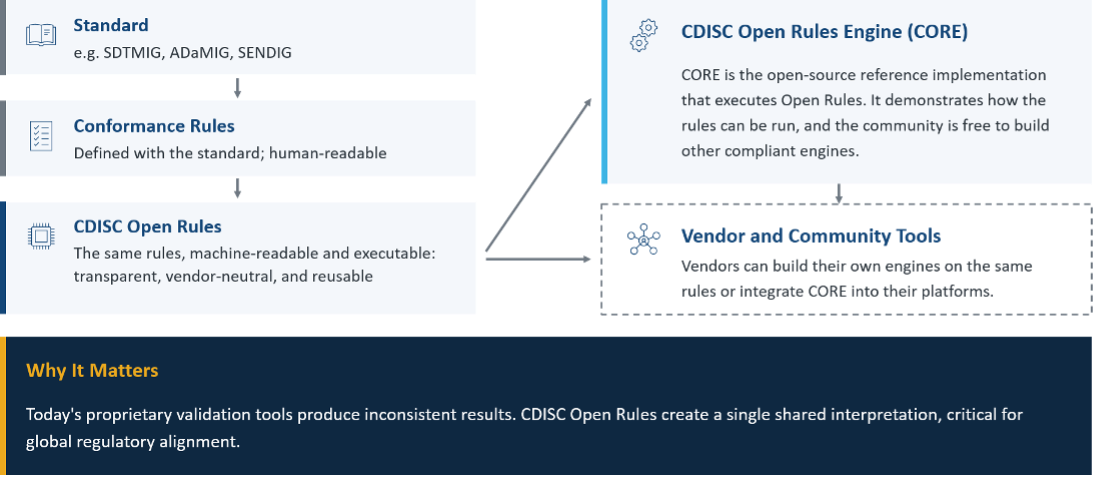
The CDISC Open Rules are openly governed, machine-executable representations of CDISC Conformance Rules and regulatory business rules.
Conformance Rules:
- Are published in Excel format and are not machine-executable
- Can be interpreted and implemented differently across organizations
- Could lead to inconsistencies in data validation and regulatory submissions
As industry best practice shifts towards applying Conformance Rules throughout the study lifecycle, to keep data as submission ready as possible, the need for a unified, reliable approach has become essential.
CDISC Open Rules directly address this need by providing an aligned, transparent, and machine-executable rules framework that supports consistency from study design through regulatory submission.
Key Objectives
- Deliver a governed set of unambiguous and executable Conformance Rules (CDISC Open Rules) for each Foundational Standard
- Provide an open-source reference implementation, the CDISC Open Rules Engine (CORE), that executes the CDISC Open Rules
- Certify engines that execute the CDISC Open Rules with results consistent with the reference implementation
Highlights and Current Status
- CDISC Open Rules packages for SDTMIG v3.2, v3.3, and v3.4 and FDA Business Rules (SDTM) are available in CDISC Library and run on CORE V1.0
- CORE V1.0, released 3 November 2026, is the first production release of the engine. Its PostgreSQL-based architecture is built to process production-scale study data
- CDISC Open Rules for TIG v1.0 and USDM v3.0 and v4.0 are available and run on CORE V0.17.1
- Rules for SENDIG, ADaM, and nonclinical FDA Business Rules are in development
- CDISC is moving toward a machine-readable rule model that separates what the rules are from how they are executed, enabling multiple interoperable and certified implementations
- The next phase depends on adopters, volunteers, and technology partners working together. The governance group will organize and facilitate an industry pilot and guide the rule model initiative (see What's Next below)
Benefits to the CDISC Community
- Ensures each standard has a set of unambiguous, machine-executable rules
- Delivers CDISC Open Rules based on Conformance Rules vetted by the CDISC standards development teams
- Ensures consistency across Conformance Rule implementations
- Expedites the availability of CDISC Open Rules for new Foundational Standards
- Allows the same rules to run on any certified engine with consistent results
What's Next
Two efforts will shape CDISC Open Rules after the CORE V1.0 release:
- Governance group. CDISC is forming a governance group with the organizations and contributors who helped build the CDISC Open Rules. The group will guide how rules are prioritized, reviewed, and published, and will steer the rule model initiative.
Industry pilot. The governance group will set up and manage an industry pilot that runs CDISC Open Rules on production study data and compares the results with current validation tools. Details will be shared as the pilot takes shape.

Learn more in the CDISC Open Rules CORE V1.0 release webinar on 10 November 2026.
Latest page content update: 3 November 2026
CDISC Open Rules are released as packages by standard and standard version, and are published in CDISC Library.
Rules package | Released | Runs on | Get it |
SDTMIG v3.2, v3.3, and v3.4 | 3 November 2026 | CORE V1.0 | CDISC Library; CORE V1.0 rule repository |
FDA Business Rules (SDTM) | 3 November 2026 | CORE V1.0 | CDISC Library; CORE V1.0 rule repository |
TIG v1.0 | 27 May 2025 | CORE V0.17.1 | CDISC Library; CORE V0.17.1 rule repository |
USDM v3.0 and v4.0 | 8 January 2026 | CORE V0.17.1 | CDISC Library; CORE V0.17.1 rule repository |
In Development
- SENDIG v3.1.1 (existing SEND rules can be run on CORE V0.17.1 but have not been fully validated)
- ADaM
- Nonclinical FDA Business Rules
Latest page content update: 3 November 2026
The CDISC Open Rules Engine (CORE), is the open-source reference implementation that executes the CDISC Open Rules.
CORE is:
- Provided as open source with the permissive MIT license
- Registered with the CDISC Open-Source Alliance (COSA)
- Available to users for free
- Run from a Command Line Interface (CLI). CORE V0.17.1 is also available as a packaged executable, a Docker image, and a Python library
Versions
Engine | Use it for | Get it |
CORE V1.0 | SDTMIG v3.2, v3.3, and v3.4; FDA Business Rules (SDTM) | CORE V1.0 repository (setup instructions in the README) |
CORE V0.17.1 | TIG, USDM, SENDIG |
Two versions of CORE are available. Choose the one that runs the rules package you need:
Documentation
- CORE Reference Guide, available to CDISC members
- CORE V0.17.1 Command Line Interface reference
- CDISC Open Rules Rule Authoring Reference Guide
Building Your Own Engine
Implementers can build their own engine or adapt CORE.
CORE is the reference for checking that another engine runs the CDISC Open Rules with the correct results, and CDISC plans a certification program for engines.
Latest page content update: 3 November 2026
Resources
- COSA | CDISC
- CDISC Announces Research Collaboration with FDA to Incorporate FDA Business Rules into CORE
- CDISC and Verisian Collaborate to Refactor CDISC Open Rules Engine (CORE) to Accelerate Development of CDISC Open Rules
- CDISC Open Rules CORE V1.0 release webinar
- CDISC Open Rules Rule Authoring Reference Guide
- CORE Reference Guide, available to CDISC members
- CORE V0.17.1 Command Line Interface reference
- CDISC CORE Collaboration LinkedIn group
Frequently Asked Questions
CDISC Open Rules are the machine-executable conformance rules. CORE is the open-source reference engine that runs them. Other engines can run the same rules.
Use CORE V1.0 for SDTMIG v3.2, v3.3, and v3.4 and FDA Business Rules.
Use CORE V0.17.1 for TIG, USDM, and SENDIG. The CORE tab links to each.
Yes. CORE is open source under the MIT License and registered with the CDISC Open-Source Alliance (COSA). CDISC does not offer CORE as a commercial product.
For data validation, CORE V1.0 accepts SAS V5 XPT and define.xml. CORE V0.17.1 accepts SAS V5 XPT and define.xml, Dataset-JSON, Dataset-NDJSON, USDM JSON, Excel, and CSV. Both versions produce reports in Excel and JSON, and CORE V0.17.1 also produces them in CSV.
Yes. Both versions of CORE use a CDISC Library API key to refresh their local cache of rules, standards metadata, and Controlled Terminology. Library accounts are set up on the CDISC Library Access page.
Yes. Both versions of CORE run local rule files, so organizations can run custom and sponsor-specific rules alongside the CDISC Open Rules. Sponsor rules are not stored in CDISC Library. See Custom Rules in the Rule Authoring Reference Guide.
CDISC plans a certification program that verifies an engine produces the same results as the reference implementation for the same CDISC Open Rules and data.
FDA Business Rules are included based on publicly available on FDA website. CDISC continues to work with regulatory agencies so the rules reflect their published requirements.