Innovate with AI, Advance CDISC Standards
The CDISC AI Innovation Challenge is a global initiative for CDISC Members designed to inspire and accelerate innovation across the clinical research ecosystem. By bringing together vendors, researchers, and forward-thinking organizations, the Challenge serves as a collaborative platform to explore how Artificial Intelligence (AI) and Machine Learning (ML) can advance the adoption and impact of CDISC standards. Launched in 2025, the Challenge more than doubled it's submissions in it's second year continues as an annual initiative, reflecting the growing demand for innovation at the intersection of AI, automation, and data standards.
Each year, participants develop solutions that address key challenges in clinical research, showcasing new ways to improve efficiency, interoperability, and data quality. Submissions are reviewed by expert judges and highlighted through CDISC events, providing visibility to leading ideas and emerging approaches.
AI Innovation Challenge celebrates the enthusiasm and commitment of the global community to advancing a more digital, connected future for clinical research aligned with our 360i Initiative.
2026 Results
2026 Winners and Runners-Up
Winners and runners-up present their solutions at the 2026 CDISC US Interchange in Denver this October, followed by dedicated webinars for each use case.
Use Case 1
AI-Enabled Synthetic Data Generation for Automation Testing
Winner
Novartis, AWS — Syn2Real, a standards-native framework that generates realistic synthetic SDTM and ADaM data from a study’s USDM definition.
Runner up
BioInformatiCo — Leova, which turns a protocol into USDM and generates repeatable synthetic-data scenarios to test study builds.
Use Case 2
AI-Driven Generation of Statistical Analysis Plans (SAP)
Winner
Saama Technologies — Smart ClinSAP, which automates the SAP workflow from protocol interpretation through executable SAS and R code.
Runner up
Jazz Pharmaceuticals — SAP-Genie, which turns a protocol into an ARS-conformant SAP and a traceable CDISC package.
Use Case 3
AI-Driven Tables, Figures, and Listings (TFL) Generation)
Winner
Novartis, AWS — PAIR, an agentic workflow that produces complete reporting packages from a SAP, ADaM specifications, and TFL shells.
Runner up
Zifo Scientific Informatics — TLFGenix, a six-agent pipeline that converts SAPs and ADaM datasets into traceable TFLs.
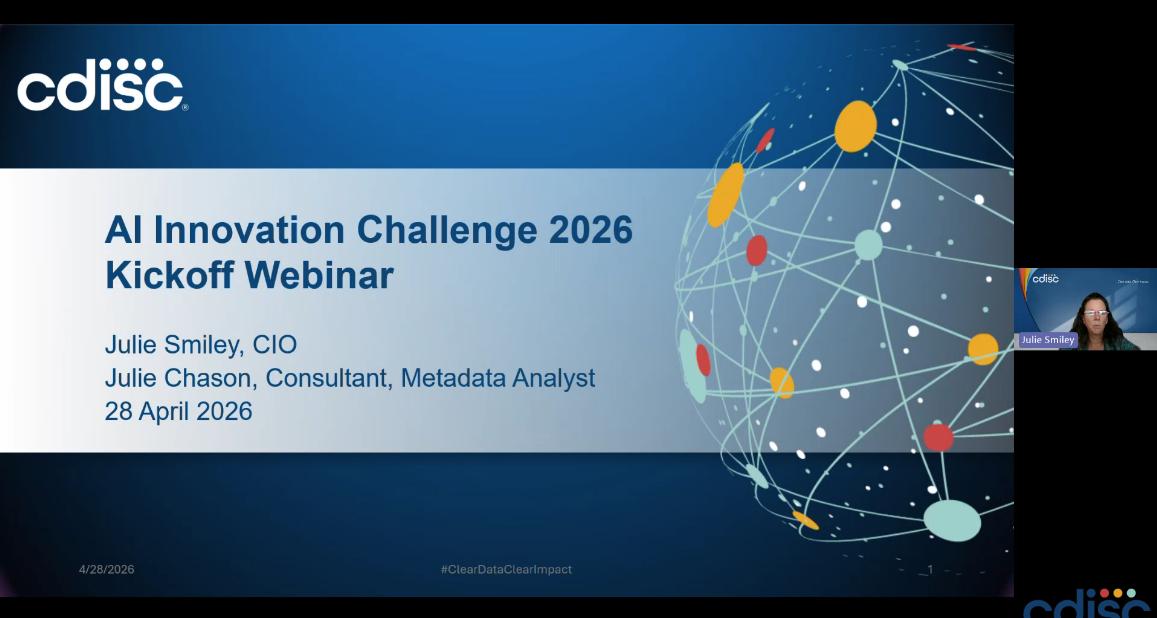
On-Demand Webinar
Watch Kickoff Webinar
Watch CDISC walk through the vision, use cases, contest timeline, submission requirements, and judging framework for the 2026 Challenge.
2025 Challenge Recap
The 2025 CDISC AI Innovation Challenge focused on three targeted use cases, advancing the digitization and automation of clinical research using AI, Machine Learning, and CDISC Standards. Watch the winning solutions below.