Innovate with AI, Advance CDISC Standards
The CDISC AI Innovation Challenge is a global initiative for CDISC Members designed to inspire and accelerate innovation across the clinical research ecosystem. By bringing together vendors, researchers, and forward-thinking organizations, the Challenge serves as a collaborative platform to explore how Artificial Intelligence (AI) and Machine Learning (ML) can advance the adoption and impact of CDISC standards. Launched in 2025, the Challenge has quickly gained strong global interest and participation from across the clinical research community. It continues as an annual initiative, reflecting the growing demand for innovation at the intersection of AI, automation, and data standards.
Each year, participants develop solutions that address key challenges in clinical research, showcasing new ways to improve efficiency, interoperability, and data quality. Submissions are reviewed by expert judges and highlighted through CDISC events, providing visibility to leading ideas and emerging approaches.
AI Innovation Challenge celebrates the enthusiasm and commitment of the global community to advancing a more digital, connected future for clinical research aligned with our 360i Initiative.
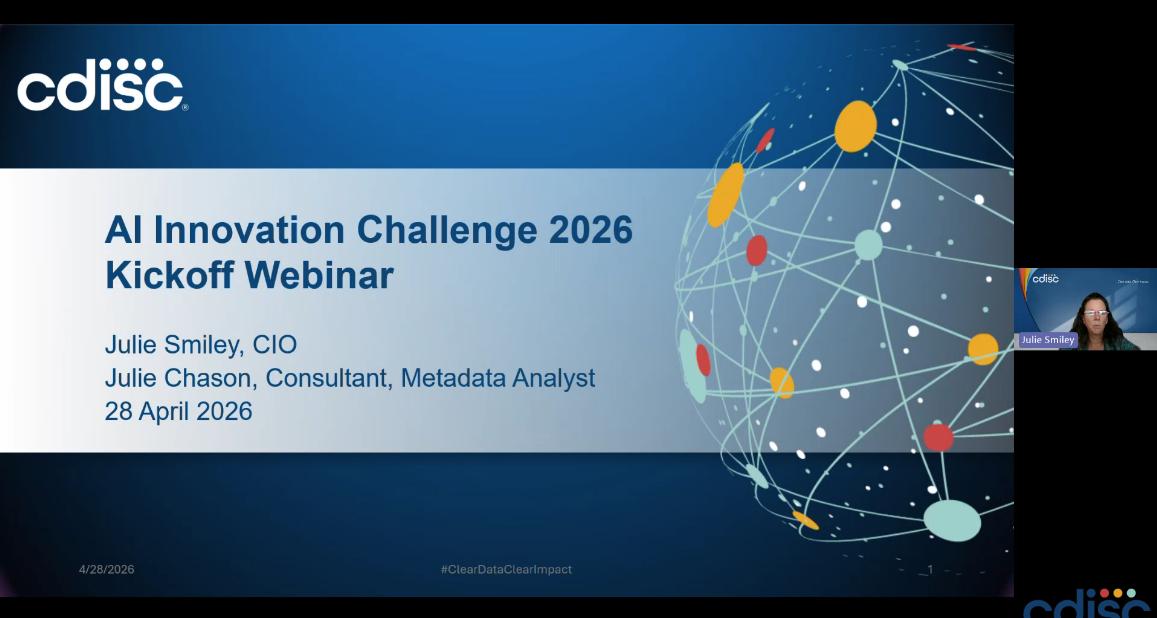
On-Demand Webinar
Watch Kickoff Webinar
Watch CDISC walk through the vision, use cases, contest timeline, submission requirements, and judging framework for the 2026 Challenge.
Challenge Timeline
Key Dates for 2026
11 Apr
Announcement
28 Apr
Kickoff Webinar
29 May
Intent Deadline
31 July
Intent Deadline
31 July
Submission Deadline
August
Judging
September
Notifications
Next
October
Showcase at US Interchange
The Frameworks
2026 Use Cases
Each submission is built around one of the following use cases.
Review all three to choose where your solution fits.
Use Case 1
AI-Enabled Synthetic Data Generation for Automation Testing
Problem
Limited access to clinical data for testing requires manual effort and makes validation of systems and workflows difficult.
Solution
Use AI/ML-driven approaches to generate synthetic SDTM and/or ADaM datasets from digital protocol or other data sources (e.g., raw, DHT, EHR, or real-world data) to reduce reliance on manual data preparation.
The Challenge
Demonstrate AI-enabled generation of synthetic SDTM and ADaM datasets with traceable linkage to source inputs and metadata.
Use Case 2
AI-Driven Generation of Statistical Analysis Plans (SAP)
Problem
SAPs are created manually, leading to inefficiencies, delays, and limited traceability to study design.
Solution
Use AI/ML-driven methods to automate generation of SAPs from protocol and metadata inputs, improving efficiency, consistency, and traceability.
The Challenge
Demonstrate AI-enabled generation of SAP content that is accurate, consistent, and traceable to study design and analysis requirements.
Use Case 3
AI-Driven Tables, Figures, and Listings (TFL) Generation
Problem
TFLs are generated manually, requiring repeated effort and limiting traceability from objective to result.
Solution
Use AI/ML-driven approaches to automate the generation of TFLs, ensuring traceability from objective to endpoint to result and reducing manual effort.
The Challenge
Demonstrate AI-enabled generation of TFLs with end-to-end traceability from objective through analysis to final outputs.
How You'll Be Scored
Judging Criteria
Each submission is scored against three weighted criteria. Standards integration and impact carries the most weight.
30%
Innovation & Relevance
- How effectively does the solution apply AI/ML to the use case?
- Does it clearly address a meaningful industry problem?
- Is the approach novel, or does it significantly advance current capabilities?
Bonus
Does it apply, promote, or accelerate development of standards in a new or impactful way?
30%
Technical Quality & Feasibility
- Is the technical approach sound, scalable, and reproducible?
- Can the solution be realistically adopted in a production environment?
- Does it handle complexity — e.g., edge cases, variability in data or inputs?
Bonus
Is there clear documentation, transparency, validation, or human-in-the-loop support?
40%
Highest Weight
Standards Integration, Traceability & Impact
- How well does the solution integrate CDISC standards?
- Does it demonstrate traceability across the data lifecycle?
- What is the potential to accelerate standards-driven automation and interoperability?
- Does it deliver measurable or visible impact — efficiency, quality, reuse, conformance?
Bonus
Is the solution interoperable, reusable, or standards-aligned in a way that increases ecosystem value?
Frequently Asked Questions
Each criterion is scored on a 1–10 scale using the descriptors below.
1–3
Weak
Minimal relevance to the use case; limited or unclear use of AI. Weak technical feasibility and little evidence of standards alignment or impact.
4–6
Adequate
Addresses the basics of the use case with some use of AI. Feasible approach, but limited innovation, standards integration, or clear impact.
7–8
Strong
Well-executed solution with meaningful use of AI. Demonstrates a solid technical approach, clear standards integration, and tangible benefits or use case alignment.
9–10
Outstanding
Breakthrough or highly differentiated solution. Demonstrates strong AI application, deep standards integration, end-to-end traceability, and high potential for real-world adoption and impact.
- 5 or more judges per use case
- Judges selected to ensure no conflict of interest
- CDISC staff and external partner and advisory stakeholders
- Independent scoring by each judge
- 1-2 sentence comments to help summarize feedback
The winners and runner-up for each use case will be invited to showcase their solution at the 2026 CDISC US Interchange in Denver in October. Following the US Interchange, the Winners will be promoted through all CDISC Communication channels and will have the opportunity to present on a dedicated Webinar highlighting their solution to our global community.
Solution development, registration, and travel to the Interchange are at the participant's own expense.
2025 Challenge Recap
The 2025 CDISC AI Innovation Challenge focused on three targeted use cases, advancing the digitization and automation of clinical research using AI, Machine Learning, and CDISC Standards. Watch the winning solutions below.